By Midcove Editorial Team, Payments & Risk · Last updated: October 20, 2026
Search for a payment gateway comparison and you’ll find no shortage of feature matrices, affiliate rankings, and strong opinions. What most of them skip is the part that actually matters: the right gateway depends on how your business sells, who writes your code, how your risk profile looks to an underwriter, and how much of the payment stack you want to own. NMI, Authorize.Net, Stripe, and PayPal are four of the most widely used gateways in North America, and each one earns its place for a different kind of merchant.
This guide walks through a practical payment gateway comparison of those four platforms: how each is positioned, where each tends to fit best, and how to weigh them against your own requirements. We deliberately avoid quoting rates or fee schedules — pricing changes often and varies by volume and industry, so the only trustworthy numbers are the ones on each provider’s current pricing page.
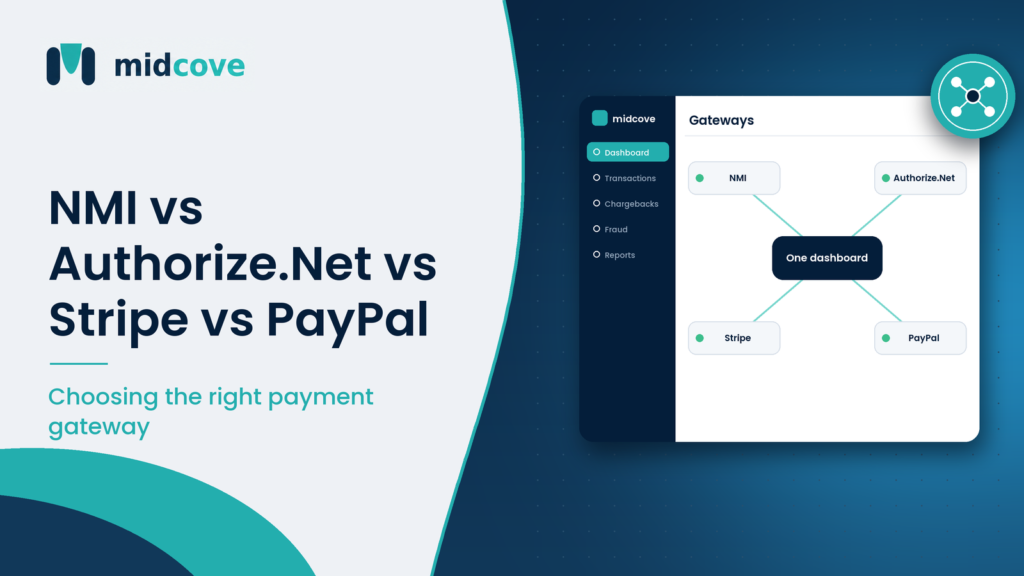
One more thing before we start: choosing a gateway is not a decision you have to relitigate every time you want better tooling. Midcove connects to the merchant account you already hold with any of these four platforms, so the software layer on top can improve without the gateway underneath changing at all. Keep that in mind as you read — it lowers the stakes considerably.
In this guide:
- How to Choose a Payment Gateway: The Criteria That Matter
- NMI: The White-Label Workhorse
- Authorize.Net: The Long-Established Standard
- Stripe: The Developer-First Full Stack
- PayPal: The Wallet Buyers Already Trust
- Side-by-Side Comparison
- You Don’t Have to Switch to Get Better Tools
- The Takeaway
- Frequently Asked Questions
How to Choose a Payment Gateway: The Criteria That Matter
Before comparing brands, get clear on what you’re actually comparing. A gateway is the service that securely carries transaction data from your checkout, virtual terminal, or app to the processing networks and back. Some gateways are just that pipe; others bundle the merchant account, the processing relationship, and a suite of commerce tools into one product. That structural difference explains most of what follows.
Six criteria separate the four platforms in this comparison more than any feature checklist:
- Merchant account model. Do you bring your own merchant account (and your own MID), or does the provider aggregate you under its own processing relationship? Bring-your-own models mean real underwriting up front but more stability and portability later. Aggregated models get you live fast but give the provider unilateral say over your account.
- Risk tolerance. If your industry is considered high-risk — supplements, coaching, travel, CBD-adjacent, anything with elevated chargebacks — a gateway that works with many acquirers and independent sales organizations will usually serve you better than one that underwrites to its own narrow appetite.
- API and developer experience. Gateway API quality determines how much engineering time integration costs you, how clean your webhooks and tokenization flows are, and how painful future changes will be.
- Checkout experience. Some gateways sit invisibly behind your branded checkout; others put a recognizable button in front of the buyer. Both approaches convert — for different audiences.
- Ecosystem and portability. How many shopping carts, CRMs, and platforms already support it? And if you ever leave, how easily do your tokenized customer records come with you?
- Compliance surface. Every option here supports PCI-compliant integration patterns, but your obligations depend on how you integrate. The PCI Security Standards Council publishes the requirements that apply regardless of which gateway you pick.
Score the four platforms below against those six criteria for your business, and the right answer usually becomes obvious. Now, the contenders.
NMI: The White-Label Workhorse
NMI is a gateway in the purest sense: infrastructure that sits between a merchant’s systems and the processing networks, without insisting on being the processor itself. It built its reputation as the platform behind the platforms — the white-label gateway that ISOs, payment facilitators, and software companies rebrand and resell under their own names. Many merchants run on NMI without ever seeing the NMI name.
That heritage shapes its strengths. NMI is processor-agnostic, which means it connects to a wide range of acquiring banks and processing relationships rather than locking merchants into one. For merchants in harder-to-place industries, that flexibility matters enormously: when the question is “which gateway for high-risk merchants,” NMI comes up constantly, because the agents and ISOs who specialize in high-risk placement overwhelmingly board their merchants onto it. It also handles the unglamorous plumbing well — recurring billing, customer vaulting, and multi-channel acceptance across e-commerce, retail, and mobile.
Best fit: merchants who work with an ISO or agent, operate in a high-risk or specialty vertical, run multiple MIDs, or want a gateway that stays constant even if the processing relationship behind it changes. If that’s you, see how Midcove’s NMI payment gateway integration layers a full CRM on top of the NMI account you already have.
Trade-off to weigh: because NMI is usually sold through resellers, your day-to-day experience depends partly on the ISO or agent managing your account — service quality varies with the partner, not just the platform.
Authorize.Net: The Long-Established Standard
Authorize.Net is one of the oldest names in online payments — it has been carrying internet transactions since the 1990s and is now owned by Visa. That longevity is its calling card. Virtually every shopping cart, invoicing tool, donation platform, and legacy ERP built in the last two decades ships with an Authorize.Net connector, and thousands of merchant service providers resell it as their default gateway.
Its structural model resembles NMI’s in one important way: Authorize.Net can pair with a merchant account from many different acquirers, so merchants keep their own underwritten processing relationship rather than being aggregated. For an established business that values institutional stability — a gateway that is not going to pivot, rebrand, or get acquired into uncertainty — the Visa ownership and the sheer length of its track record carry real weight.
In the perennial NMI vs Authorize.Net debate, the honest answer is that they overlap heavily: both are bring-your-own-merchant-account gateways with broad acquirer compatibility. NMI leans toward ISOs, white-label deployments, and high-risk placement; Authorize.Net leans toward mainstream merchants who want the most widely supported, most battle-tested option and a brand their bank and their developer have both heard of.
Best fit: established small and mid-size merchants, businesses on older commerce platforms with built-in Authorize.Net support, and anyone whose bank or merchant service provider recommends it as the house gateway. Already boarded there? Midcove’s Authorize.Net integration connects to your existing account without touching your underwriting.
Trade-off to weigh: a platform this mature moves deliberately. Its tooling is dependable, but merchants who want the newest checkout and API patterns the moment they appear tend to look elsewhere.
Stripe: The Developer-First Full Stack
Stripe took the opposite approach from the two gateways above: instead of being a neutral pipe in front of someone else’s merchant account, it built the whole stack — gateway, processing, onboarding, payouts — behind one famously well-documented API. Developers love it for a reason. Integration that once took weeks of certification work became an afternoon with clean libraries, sensible webhooks, and documentation that other companies now imitate. If gateway API quality is your first sorting criterion, Stripe set the bar everyone else is measured against.
The model has a flip side. Stripe onboards most merchants under its own aggregated processing relationship, which is exactly why signup is nearly instant — and also why Stripe applies its own risk standards on an ongoing basis. Merchants in restricted or elevated-risk categories can find themselves outside Stripe’s published acceptable-use terms, sometimes after they’ve already begun processing. Fast onboarding and conservative risk appetite are two sides of the same design.
Best fit: software companies, SaaS and subscription businesses, marketplaces, and any merchant whose engineering team wants to build a custom payment experience quickly in a mainstream, lower-risk vertical. If Stripe is your platform, Midcove’s Stripe payment gateway integration adds virtual terminal, chargeback, and fraud tooling on top of the Stripe account you already run.
Trade-off to weigh: the convenience of the aggregated model means less individual underwriting up front — and correspondingly less certainty for merchants whose business model sits near the edges of Stripe’s risk policy.
PayPal: The Wallet Buyers Already Trust
PayPal is the only name in this comparison your customers already know. It began as a consumer wallet, and that consumer-side brand recognition remains its core commercial asset: hundreds of millions of buyers have PayPal credentials, and a familiar PayPal button at checkout removes the friction of typing card details on a site the buyer has never purchased from before. For merchants selling to new or cautious audiences, that trust signal is a genuine conversion lever no purely back-end gateway can offer.
On the merchant side, PayPal has grown well beyond the button. It offers full processing and gateway capabilities, and many businesses run it alongside a traditional card gateway rather than instead of one — cards flow through NMI or Authorize.Net while the PayPal button captures wallet-preferring buyers. In a Stripe vs PayPal decision, the cleanest distinction is direction: Stripe optimizes for the developer building the checkout, PayPal optimizes for the buyer standing at it. Plenty of merchants conclude the answer is both.
Best fit: consumer-facing e-commerce, marketplaces and casual sellers, businesses with international buyers, and any merchant whose audience skews toward wallet payments over typed card entry. Midcove’s PayPal payment gateway integration pulls that activity into the same dashboard as your other channels.
Trade-off to weigh: like Stripe, PayPal manages risk across an enormous aggregated merchant base, and its dispute and account-review processes are built for that scale — merchants should read its acceptable-use and reserve policies carefully before leaning on it as a sole processing channel.
Side-by-Side Comparison
Here’s the qualitative picture in one place. For anything involving numbers — rates, monthly fees, per-transaction pricing — go straight to each provider’s current pricing page; published summaries go stale quickly and negotiated pricing varies by merchant.
| Criteria | NMI | Authorize.Net | Stripe | PayPal |
|---|---|---|---|---|
| Core positioning | White-label, processor-agnostic gateway | Long-established, Visa-owned gateway | Developer-first full-stack processor | Consumer wallet plus merchant processing |
| Merchant account model | Bring your own (via ISO/acquirer) | Bring your own (broad acquirer support) | Typically aggregated under Stripe | Typically aggregated under PayPal |
| High-risk friendliness | Strong — the ISO/high-risk channel’s default | Moderate — depends on the acquirer behind it | Limited — governed by Stripe’s own risk policy | Limited — governed by PayPal’s own risk policy |
| Developer experience | Capable, oriented to integrators and platforms | Mature and stable, older API patterns | Industry benchmark for API quality | Broad SDKs, wallet-centric flows |
| Buyer-facing brand | Invisible — white-label by design | Mostly invisible behind checkout | Mostly invisible behind checkout | Highly visible — recognition is the point |
| Typical best fit | ISO-boarded, multi-MID, and high-risk merchants | Established SMBs on mainstream platforms | SaaS, marketplaces, engineering-led teams | Consumer e-commerce and wallet-first buyers |
| Works with Midcove | Yes | Yes | Yes | Yes |
You Don’t Have to Switch to Get Better Tools
Here is the part most gateway comparisons leave out: many merchants reading them don’t actually have a gateway problem. They have a tooling problem. The gateway moves transactions fine — what’s missing is a decent virtual terminal, searchable transaction history, chargeback alerts with evidence workflows, or fraud rules more nuanced than an on/off switch. Switching gateways to fix that means re-integration, and if a merchant account change comes with it, re-underwriting, rate resets, and possible downtime.
Midcove exists for exactly that gap. It connects to the existing account you hold with NMI, Authorize.Net, Stripe, or PayPal — no new MID, no re-underwriting — and puts a full management layer on top: virtual terminal with AVS/CVV checks, transaction and refund management, chargeback case tracking, and fraud prevention with IP, email, phone, and BIN blocking. Because every gateway is normalized behind one unified payment gateway API, you can even run more than one of these platforms at once — NMI for cards, PayPal for wallet buyers — from a single login, and add or swap gateways later without rebuilding your operations around a new dashboard.
That changes how you should read the comparison above. Pick the gateway whose processing model and risk fit match your business — and treat the management software as a separate decision, because it is one.
The Takeaway
There is no universally best gateway, only a best fit. NMI wins for ISO-boarded, multi-MID, and high-risk merchants who want processor flexibility. Authorize.Net wins for established merchants who value two decades of ecosystem support and Visa-backed stability. Stripe wins when developer velocity and API quality drive the decision in a mainstream vertical. PayPal wins wherever buyer trust and wallet convenience move conversion. Verify current pricing directly with each provider, weigh the merchant-account model as heavily as the feature list — and remember that whichever platform you land on, the tools you use to manage it can be dramatically better than the gateway’s own defaults.
Frequently Asked Questions
What is the difference between a payment gateway and a payment processor?
A gateway securely transmits transaction data from your checkout or terminal to the card networks; a processor executes the transaction and moves the money through your merchant account. NMI and Authorize.Net are primarily gateways that pair with a separate processing relationship, while Stripe and PayPal bundle gateway and processing into one service.
Which payment gateway is best for high-risk merchants?
NMI is the most common choice, because it is processor-agnostic and widely used by the ISOs and agents who specialize in placing high-risk merchants with willing acquirers. Authorize.Net can also work when paired with a high-risk-friendly acquirer. Stripe and PayPal apply their own risk policies and exclude many elevated-risk categories.
What is the main difference between NMI and Authorize.Net?
Both are bring-your-own-merchant-account gateways with broad acquirer support, so they overlap heavily. NMI is built for white-label and ISO channels and is the default in high-risk placement, while Authorize.Net is the longer-established, Visa-owned option with the widest built-in support across mainstream shopping carts and business software.
Should I choose Stripe or PayPal?
They optimize for different sides of the transaction. Stripe is developer-first, with an API built for teams creating custom checkout and billing experiences. PayPal is buyer-first, offering a wallet button that customers already recognize and trust. Many merchants run both: custom card checkout through one channel and a PayPal button for wallet-preferring buyers.
Do Stripe and PayPal give me my own merchant account?
Typically no. Both usually onboard merchants under their own aggregated processing relationships, which is why signup is fast and there is little up-front underwriting. The trade-off is that each provider applies its own ongoing risk review and can restrict accounts that fall outside its acceptable-use policies.
How do I compare payment gateway pricing accurately?
Go directly to each provider’s current pricing page rather than relying on third-party summaries, which go stale quickly. Rates also vary by industry, volume, and negotiation, especially for bring-your-own-merchant-account gateways where pricing comes from your acquirer or ISO rather than the gateway itself.
Which gateway has the best API for developers?
Stripe is widely regarded as the benchmark for API design and documentation. NMI offers capable APIs oriented toward integrators and platforms, Authorize.Net provides mature and stable interfaces that reflect its longer history, and PayPal offers broad SDKs centered on wallet and checkout flows. Weigh API quality against fit on risk and account model.
Can I use more than one payment gateway at the same time?
Yes, and many merchants do — for example, running card payments through NMI or Authorize.Net while offering a PayPal button for wallet users. Midcove supports multi-gateway processing across NMI, Authorize.Net, Stripe, and PayPal from one dashboard, so multiple gateways do not mean multiple disconnected back offices.
Do I need to switch gateways to get better payment management tools?
Usually not. If your gateway processes reliably but its dashboard, reporting, or chargeback tools fall short, a management layer like Midcove connects to your existing NMI, Authorize.Net, Stripe, or PayPal account and adds a virtual terminal, transaction management, chargeback tracking, and fraud prevention without re-integration or re-underwriting.
Are all four of these gateways PCI compliant?
All four support PCI-compliant integration methods, but your own compliance obligations depend on how you integrate and handle card data. Using hosted fields or tokenized flows reduces your scope. The PCI Security Standards Council publishes the requirements that apply to merchants regardless of which gateway carries the transaction.