By Midcove Editorial Team, Payments & Risk · Last updated: October 20, 2026
Every business that accepts card payments does it through a merchant account, but not every merchant account is created on the same terms. If a processor labels your business a high-risk merchant account, almost everything about the relationship changes: the questions asked during underwriting, the pricing you’re offered, the reserves held against your deposits, and how closely your transactions are watched after approval. None of that means your business is bad. It means the processor expects a higher chance of chargebacks, refunds, fraud, or regulatory complications, and prices the account accordingly.
The frustrating part for most merchants is that the classification often happens before they’ve processed a single transaction. High-risk payment processing decisions are driven largely by category: what you sell, how you bill for it, and how your industry has historically performed across the card networks. A merchant with a spotless record can still be classified high-risk simply because of the business they’re in.
This guide explains the real differences between standard and high-risk merchant accounts: why merchants get classified high-risk, how high-risk underwriting works, what changes in cost and contract terms, and, most importantly, what high-risk merchants can do to protect the merchant account they worked hard to get approved.
In this guide:
- What makes a merchant account “high-risk”?
- How high-risk underwriting differs
- Cost and contract differences: rates, reserves, and terms
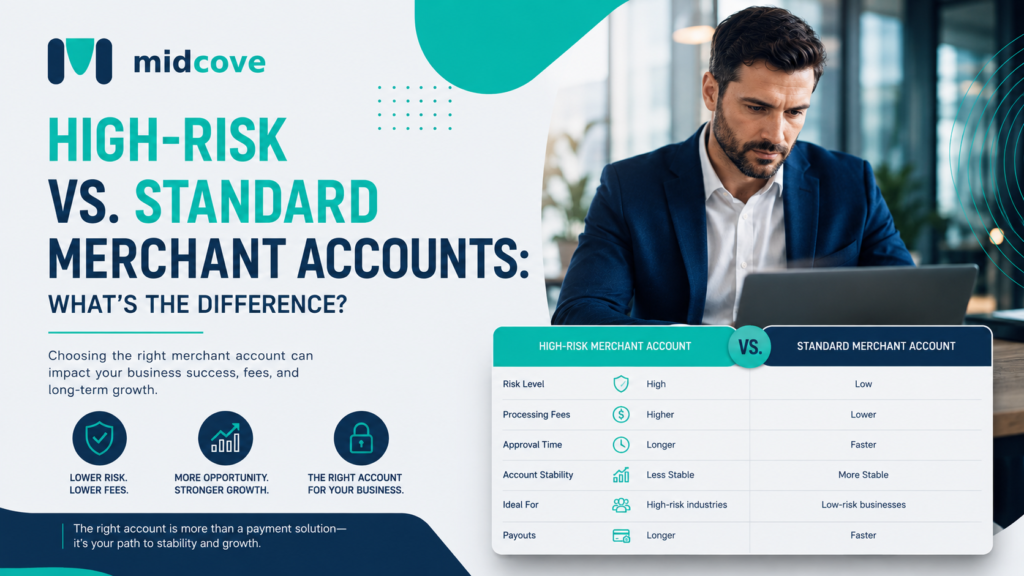
- Standard vs. high-risk at a glance
- How high-risk merchants protect their MID
- The takeaway
- Frequently asked questions
What Makes a Merchant Account “High-Risk”?
There is no single industry-wide registry that stamps a business “high-risk.” Each acquiring bank and processor sets its own risk policy, guided by card network rules and its own loss history. That said, the factors they weigh are remarkably consistent across the industry.
Industry and business model
Some verticals are treated as high-risk almost by default: travel, nutraceuticals and supplements, CBD, online gaming, adult content, ticketing, coaching and info products, debt services, and subscription boxes, among others. The common threads are elevated dispute rates, regulatory scrutiny, or a long gap between payment and delivery. If a customer pays today for a flight or an event months away, the processor carries the risk that the merchant fails to deliver, because cardholders can dispute undelivered goods long after the sale. Many of these are the same verticals covered on our industries we serve page, because they tend to need stronger payment tooling than a generic setup provides.
Chargeback history and chargeback ratio
Your chargeback ratio, which is generally calculated as the number of chargebacks in a month divided by your transaction count, is the single most-watched number in merchant risk. Card networks like Visa and Mastercard operate formal dispute monitoring programs, and merchants who exceed the networks’ published thresholds face escalating fines and, eventually, the loss of processing privileges. A business with a history of elevated disputes, at a previous processor or under a previous name, will be classified high-risk regardless of what it sells.
Average ticket size and transaction pattern
Large average tickets concentrate risk: a single disputed $5,000 transaction hurts far more than a disputed $20 one. Processors also look at velocity and volatility. A merchant with wildly fluctuating monthly volume, seasonal spikes, or a sudden surge in transaction size looks riskier than one with a steady, predictable pattern, because instability is where fraud and merchant failure tend to hide.
Billing model
How you charge matters as much as what you charge. Card-not-present sales carry more fraud exposure than in-person ones. Recurring billing, free trials that convert to paid subscriptions, and negative-option billing all generate more “I didn’t authorize this” disputes than one-time purchases. Advance deposits and pre-orders stretch the delivery window. If your billing model routinely surprises cardholders, underwriters assume your chargeback ratio will show it.
Merchant-specific factors
Finally, underwriters look at the business itself: time in operation, processing history, the owner’s credit profile, prior merchant account terminations, and whether the business appears on industry watchlists such as the MATCH list. A previous account termination is one of the heaviest flags a merchant can carry into a new application.
How a High-Risk Merchant Account Is Underwritten
Standard underwriting is often fast and lightly automated. For a low-risk retail or services business, a processor may approve the application in hours based on basic identity checks, a soft credit review, and the stated business type. If you’ve read our explainer on what a MID (merchant ID) is, you know that approval ends with the processor issuing that identifier and taking responsibility for your transactions on the network.
High-risk underwriting is a different exercise. Because the processor is exposed to more potential loss, it does the review a human, and usually a specialized risk team, would do:
- Deeper documentation. Expect requests for several months of processing statements, bank statements, financials, supplier agreements, licenses for regulated products, and detailed descriptions of your fulfillment and refund practices.
- Website and policy review. Underwriters read your site the way a suspicious cardholder would: are the billing descriptor, refund policy, terms, and contact information clear? Vague policies predict disputes.
- Owner-level scrutiny. Personal credit, prior ventures, and any history of terminated accounts or MATCH listings get examined closely.
- Volume caps and conditions. Approval often comes with a monthly processing cap, a maximum ticket size, or delivery-timeframe conditions that are revisited as the merchant builds history.
The practical differences are time and certainty. A standard account might be live in a day; a high-risk approval can take days or weeks, and it may arrive with conditions attached. That is also why high-risk merchants guard an approved account so carefully; replacing it means going through the whole process again, from a weaker position.
Cost and Contract Differences: Rates, Reserves, and Terms
Once approved, a high-risk merchant pays for the extra risk the processor is carrying. The specific numbers vary widely by industry, history, and provider, so treat any quoted “typical high-risk rate” with skepticism, but the structural differences are consistent.
Higher processing rates and fees
High-risk accounts pay noticeably more per transaction than comparable standard accounts, and often carry higher monthly fees, setup fees, and per-chargeback fees as well. The premium reflects expected losses from disputes and fraud, plus the cost of the manual monitoring the processor commits to. Rates usually improve over time as a merchant demonstrates clean processing history, which is one more reason protecting the account pays off.
Rolling reserves and other holdbacks
A rolling reserve is the signature feature of high-risk payment processing. The processor withholds a percentage of each settlement and holds it for a defined period, commonly several months, releasing older funds on a rolling basis as new ones are held. The reserve exists to cover chargebacks and refunds if the merchant fails or walks away. Some processors instead use a capped reserve (withholding until a fixed amount is reached) or an upfront reserve funded before processing begins. Whatever the structure, reserves are a real cash-flow cost that standard merchants simply don’t face, and they should be negotiated and reviewed as your history improves.
Contract terms and termination risk
High-risk agreements tend to run longer, carry early-termination fees more often, and give the processor broader rights to hold funds, raise reserves, or terminate the account if the merchant’s chargeback ratio climbs or its business model changes without notice. Standard merchants get terminated too, but for high-risk merchants the tripwires are closer and the monitoring that triggers them is constant.
Standard vs. High-Risk Merchant Accounts at a Glance
| Dimension | Standard merchant account | High-risk merchant account |
|---|---|---|
| Underwriting | Fast, largely automated; basic identity and credit checks; often approved same day | Manual review by a risk team; financials, processing statements, policy and website review; days to weeks |
| Rates & fees | Lower per-transaction pricing; standard monthly and chargeback fees | Premium per-transaction pricing; higher monthly, setup, and per-chargeback fees |
| Reserves | Rarely required | Rolling, capped, or upfront reserves are common and withheld from settlements |
| Volume limits | Generous or none | Monthly caps and maximum ticket sizes, loosened as history builds |
| Ongoing monitoring | Routine, mostly automated | Continuous scrutiny of chargeback ratio, refund rate, and volume pattern |
| Termination risk | Low, absent fraud or major policy violations | Elevated; dispute spikes or unannounced model changes can trigger holds or termination |
| Contract terms | Shorter terms, simpler exit | Longer terms, early-termination fees, broader processor rights over funds |
The pattern behind every row is the same: the processor prices in the losses it expects and builds itself escape hatches. The merchant’s counter-move is to make those expected losses not happen, and to be able to prove it.
How High-Risk Merchants Protect Their MID
For a high-risk merchant, the approved account is an asset. Losing it means re-underwriting from a worse position, likely with a termination on record. The merchants who keep their accounts for years treat risk management as a daily operating discipline, not a crisis response.
Run fraud filters before transactions settle
Most disputes that destroy accounts start as fraud the merchant could have blocked. Screening tools such as AVS and CVV verification, IP and email blocking, BIN filtering, and velocity lockouts stop bad transactions before they become chargebacks. Dedicated payment fraud prevention software lets you tune those rules to your risk profile instead of relying on whatever defaults your gateway shipped with, and platforms built for merchant risk management add the monitoring layer on top: watching your dispute and refund trends so you see a problem weeks before your processor’s risk team does.
Respond to every dispute, fast
Chargebacks have deadlines measured in days. A merchant who receives alerts immediately, pulls order evidence quickly, and responds inside the window both recovers more revenue and demonstrates operational competence to their processor. Centralized chargeback management software, with alerts, evidence upload, and case tracking in one place, turns dispute response from a scramble into a routine.
Refund fast and generously
Counterintuitive but true: for a high-risk merchant, a refund is often cheaper than a win. A refunded customer rarely files a chargeback; a chargeback hits your ratio whether you win the case or not. Fast, low-friction refunds, clear policies, a recognizable billing descriptor, and same-day processing keep disputes from ever being filed. Speed matters most, since a refund issued after the cardholder has already called their bank does nothing for your ratio.
Keep everything visible in one place
Risk management fails in silos, when transactions live in a gateway report, disputes in an email inbox, and refunds in a spreadsheet. A payment CRM that consolidates transactions, chargebacks, refunds, and fraud rules into a single dashboard, connected to the merchant account you already have, gives you one view of the numbers your processor is watching. For merchants operating under a rolling reserve and a volume cap, that visibility is the difference between managing risk and discovering it in a termination letter.
The Takeaway
The difference between standard and high-risk merchant accounts comes down to how much loss the processor expects and how it protects itself: heavier underwriting, premium pricing, rolling reserves, tighter monitoring, and a shorter fuse on termination. You often can’t control the classification, because industry alone can put you in the high-risk bucket. What you can control is everything the classification is based on going forward: your fraud exposure, your dispute response, your refund speed, and your chargeback ratio.
Merchants who run those numbers well don’t just keep their accounts. They earn lower reserves, higher caps, and better rates over time, because underwriting never really ends; it just becomes monitoring. Manage what’s being monitored, and a high-risk classification becomes a pricing detail instead of an existential threat.
Frequently Asked Questions
What is a high-risk merchant account?
A high-risk merchant account is a payment processing account issued to a business the processor expects to generate above-average chargebacks, fraud, refunds, or regulatory exposure. It works like any other merchant account but comes with stricter underwriting, higher pricing, and often a reserve on funds.
Why was my business classified as high-risk?
Common reasons include your industry category, a history of elevated chargebacks, large average ticket sizes, recurring or trial-based billing, long delivery windows, limited processing history, or a prior merchant account termination. Industry alone is often enough, even with a clean record.
What is a rolling reserve?
A rolling reserve is a percentage of each settlement that the processor withholds and holds for a defined period, releasing older funds as new ones are held. It exists to cover chargebacks and refunds if the merchant fails, and it is one of the most common conditions attached to high-risk accounts.
What is a chargeback ratio and why does it matter?
A chargeback ratio is generally the number of chargebacks you receive in a month divided by your transaction count. Card networks run formal monitoring programs with published thresholds, and merchants who exceed them face fines and eventually the loss of processing privileges, so it is the most closely watched number on a high-risk account.
How is high-risk underwriting different from standard underwriting?
Standard underwriting is fast and largely automated. High-risk underwriting involves a manual review by a risk team: processing and bank statements, financials, website and refund policy review, and owner-level checks. It takes longer and approval often comes with volume caps or reserve requirements.
Do high-risk merchants always pay higher rates?
Generally yes, because the processor prices in expected losses and the cost of extra monitoring. The exact premium varies widely by industry, history, and provider. Rates and reserve terms usually improve as a merchant builds a clean processing history, so they are worth renegotiating over time.
Can a high-risk merchant account be terminated?
Yes, and more readily than a standard account. Dispute spikes, refund surges, sudden volume changes, or changing your business model without notifying the processor can trigger holds, higher reserves, or termination. A termination also makes future approvals harder, which is why protecting the account matters so much.
Can I move from high-risk to standard classification?
Sometimes. If your classification was driven by limited history or past chargebacks rather than industry, a sustained record of low disputes and stable volume can earn lower reserves, higher caps, and better pricing. Merchants in permanently high-risk verticals usually stay classified high-risk but can still improve their terms significantly.
How do fraud filters help protect a high-risk account?
Tools like AVS and CVV checks, IP, email, and BIN blocking, and velocity lockouts stop suspicious transactions before they settle. Every fraudulent transaction blocked is a chargeback that never hits your ratio, which directly protects the metric your processor watches most closely.
Do I need a new merchant account to get better risk management tools?
No. Platforms like Midcove connect to the merchant account you already have with NMI, Authorize.Net, Stripe, or PayPal and add fraud filters, chargeback management, refund tools, and risk monitoring on top. You keep your MID, your rates, and your processing history, with no re-underwriting.