Last updated: October 19, 2026
A supplement brand learned the hard way why one gateway is a single point of failure. Its only MID got flagged for review after a bad influencer campaign drove a wave of “I didn’t order this” disputes. For eleven days, deposits slowed to a trickle while the acquirer investigated. Subscriptions kept renewing, but the money wasn’t landing.
Today that brand runs two MIDs: NMI through its ISO for subscriptions, and Stripe for one-time orders. That’s multi-gateway payment processing in its simplest form. It isn’t exotic anymore. Plenty of mid-sized merchants run two or three gateways for reasons that have nothing to do with complex routing engines.
This guide covers why businesses run more than one gateway, the three routing models (and which ones actually require special software), the operational overhead nobody mentions in sales demos, how to reconcile across gateways, and a practical setup for managing it all. It’s written from the ops side: the person who has to answer “why doesn’t this deposit match?” on a Monday. We build Midcove, a management layer for multi-MID merchants, so we’ll be direct about where routing software fits and where it doesn’t.
Multi-gateway payment processing means accepting card payments through two or more payment gateways or merchant accounts at the same time. Businesses do it to separate brands or risk, serve different regions, add a backup, or use each gateway’s strengths. Transactions can be assigned manually, by rules, or by automated routing software.
Table of Contents
Why Run Multiple Gateways?
There are five common reasons. Most merchants have two of them at once.
1. Separate brands or business lines
A company that sells skincare and also runs a paid membership community has two very different risk profiles. Keeping them on separate MIDs means each has its own descriptor, its own chargeback ratio, and its own relationship with the acquirer. Our sibling post on multiple MIDs for multiple brands covers the structure in detail.
2. Risk separation
Higher-risk products, like trial offers or high-ticket coaching, can sit on a MID with an acquirer that understands them. Lower-risk sales go on a standard account with better rates. This is legitimate when each product truly belongs on its account and is described accurately to each acquirer.
3. Regional coverage
A US software company selling into Saudi Arabia and the UAE might use Authorize.Net for US customers and a regional acquirer’s gateway for GCC cards, where local acquiring can improve approval rates and settle in local currency.
4. Redundancy
Gateways have outages. Acquirers freeze accounts. A second, active MID means you can keep selling while you sort out the first. We cover this scenario in why you need a backup payment processor.
5. Feature fit
Stripe is strong for developer-built checkouts and subscriptions. PayPal brings its own wallet users. NMI is popular with ISOs and higher-risk boarding. Authorize.Net has long-established customer profile and recurring billing APIs. Using two gateways can simply mean using each for what it does best.
Multi-Gateway Payment Processing Routing Models
“Routing” sounds technical, but it just means deciding which MID handles which transaction. There are three ways to do it. Be honest with yourself about which one you need.
Manual selection
A person or a fixed setting picks the MID. Your US store always charges MID A. Phone orders for the coaching program go through MID B. An agent in the virtual terminal picks from a dropdown. No logic runs at checkout.
Rules-based routing
Code or a platform applies if-then rules per transaction: if the currency is AED, send to the GCC gateway; if the amount is over $2,000, send to the high-ticket MID. You can build simple rules into your own checkout, or use an orchestration platform.
Smart or dynamic routing
An orchestration platform chooses the MID in real time based on live data such as approval rates by BIN, cost, or gateway health. It may retry soft declines on another gateway and fail over automatically during an outage. Adyen’s overview of payment orchestration describes this layer and its trade-offs, including added complexity.
| Model | How the MID is chosen | Build effort | Good fit | Watch out for |
|---|---|---|---|---|
| Manual | Fixed per store, product, or agent choice | Low | 2–5 MIDs split by brand, product, or channel | No automatic failover; switching takes a config change |
| Rules-based | If-then logic per transaction | Medium | Clear splits by currency, region, or amount | Rules drift and break quietly |
| Smart/dynamic | Real-time data and models | High | High volume, many providers, global reach | Cost, vendor lock-in, compliance risk if misused |
Here’s the uncomfortable truth: most businesses with two or three MIDs split by brand or product don’t need dynamic routing at all. Each transaction already has an obvious home. What they need is a way to see and manage all the MIDs together. If you’re weighing a full platform, read our sibling guide to what payment orchestration software does and when it’s overkill.
The Operational Overhead
Every gateway you add multiplies routine work. Plan for it before you sign the second merchant agreement.
- Logins and permissions. Each console has its own users. Offboarding an employee means remembering every portal.
- Refunds. A refund must go back through the MID that took the original payment. Support needs to know which one that was.
- Disputes. Chargeback notices arrive in different formats and places, each with its own deadline.
- Fraud rules. A fraudster blocked on Stripe Radar isn’t blocked on NMI. Card testers notice gaps.
- Reporting. Each gateway defines and exports data differently. Approval rate on one may not match the definition on another.
- PCI scope. More integrations mean more places to check how card data flows.
As a rough rule of thumb rather than a benchmark, each extra gateway adds a few hours a week of console-hopping for a small team, and more in dispute-heavy months. That cost never shows up on the rate sheet, but it shows up in payroll.
Reconciliation Across Gateways
Reconciliation is where multi-gateway setups usually break first. The sales numbers look fine; the bank deposits don’t match.
Why the numbers drift
- Batch cut-off times differ by gateway and by your settings.
- Some processors deposit net of fees; others deposit gross and bill fees monthly.
- Refunds, chargebacks, and reserve holds come out on different days.
- Currency conversion happens at different points for foreign cards.
A reconciliation routine that works
- Pull a daily settlement report from each gateway, or one combined export if your tooling supports it.
- Match each batch total to the corresponding bank deposit, noting fee treatment per MID.
- List refunds and chargebacks separately by MID with their posting dates.
- Flag any deposit that differs from the batch by more than a set tolerance.
- Close the week with a per-MID summary: gross sales, refunds, chargebacks, fees, net deposit.
A combined transaction management dashboard cuts steps 1 and 3 from an hour of CSV wrangling to a filter and an export.
Card Network Rules You Can’t Ignore
Card networks monitor each merchant account separately. That’s useful for brand separation. It’s also why spreading transactions across MIDs to dilute chargeback ratios is a serious violation.
How ratios are measured
Under Visa’s Acquirer Monitoring Program (VAMP), disputes plus reported fraud are divided by settled transactions in the same month. Stripe’s summary of card network monitoring programs lists the Excessive merchant threshold at a 1.5% ratio and 1,500 count for the US, Canada, Europe, Asia Pacific, and Latin America. Mastercard’s Excessive Chargeback Merchant level starts at 100 chargebacks and a 1.5% ratio, measured against the previous month’s transactions.
The line you must not cross
Running separate MIDs for genuinely separate businesses, regions, or products is normal. Splitting one product’s volume across several MIDs so no single account trips a threshold is not. Acquirers and networks call it load balancing or MID stacking, and it can lead to termination and a listing on Mastercard’s MATCH file. Each MID should be underwritten for what it actually sells.
The practical takeaway: monitor ratios per MID, not as a blended total. A blended 0.6% can hide one account sitting at 1.4%.
How to Manage Multiple Gateways Step by Step
- Document every MID. Gateway, acquirer, descriptor, what it sells, who owns it, monthly volume.
- Define the assignment rule. Write down exactly which transactions go to which MID. If you can’t, you have a structure problem, not a tooling problem.
- Choose one operational home. Pick the tool where refunds, disputes, and fraud blocks happen. Gateway consoles become read-only for most staff.
- Share fraud lists across MIDs. An email or BIN blocked on one account should be blocked on all of them.
- Set per-MID ratio alerts. Warn well below network thresholds so you have time to act.
- Prepare a manual failover plan. If MID A goes down, who switches checkout to MID B, and how long does it take? Test it once a quarter.
- Review monthly. Approval rate, refund rate, and chargeback ratio by MID, side by side.
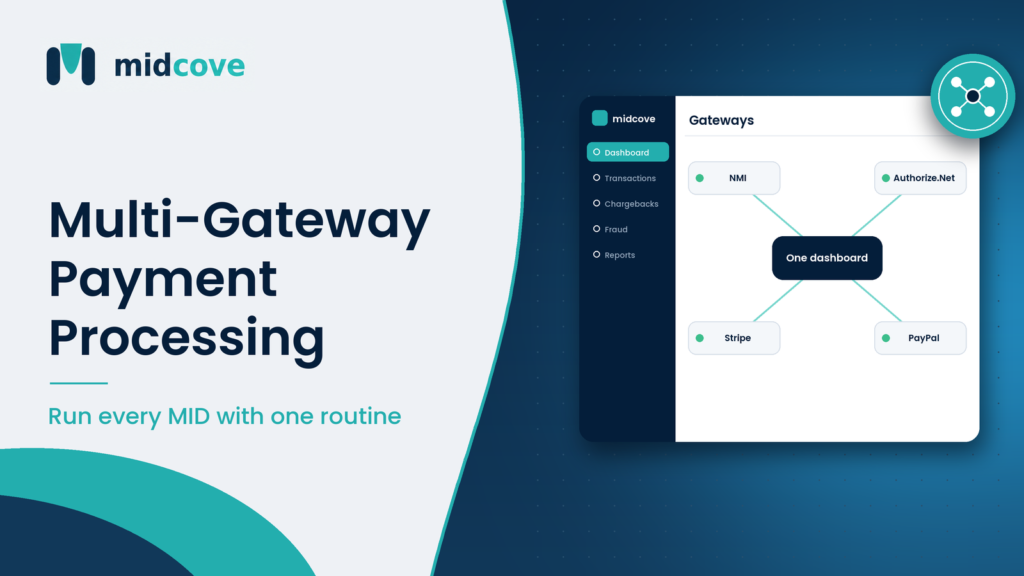
Midcove handles steps 3 through 5 and 7 for NMI, Authorize.Net, Stripe, and PayPal accounts: one login, one dispute queue, shared block lists, and per-MID payment reporting. To be clear about what it doesn’t do: Midcove doesn’t route or fail over automatically. You pick the MID for each charge or channel, and it manages everything after.
Key Takeaways
- Multi-gateway payment processing is common for brand separation, risk separation, regional coverage, redundancy, and feature fit.
- Routing can be manual, rules-based, or dynamic. Most merchants with a few MIDs split by brand need only manual assignment.
- Each extra gateway adds overhead in logins, refunds, disputes, fraud rules, and reporting.
- Reconciliation breaks first; build a daily per-MID routine.
- Networks monitor each MID separately. Splitting volume to hide chargebacks breaks the rules.
- Pick one operational home for refunds, disputes, and fraud lists across every MID.
Frequently Asked Questions
Can a business use two payment gateways at the same time?
Yes. Many merchants run two or more gateways at once, each tied to its own merchant account. Your website or virtual terminal decides which one handles each payment. Make sure each MID is approved for the products you run through it, and that your team knows where refunds and disputes for each live.
What are the benefits of multiple payment gateways?
The main benefits are resilience if one account is frozen or down, separation of brands or risk levels, better regional coverage, and using each gateway’s strengths. The costs are extra operational work, harder reconciliation, and more places to monitor fraud and chargebacks.
What is payment routing?
Payment routing is the decision about which gateway or merchant account processes each transaction. It can be a fixed choice per store or product, a set of if-then rules, or a real-time decision by an orchestration platform based on approval rates, cost, or gateway health.
Do I need payment orchestration to use multiple gateways?
No. Orchestration helps when you need automatic routing, retries, or failover at high volume. If your MIDs are split cleanly by brand, product, or channel, manual assignment works, and a management tool that gives one view of all MIDs is often enough.
Is it legal to split transactions across merchant accounts?
Running separate accounts for separate businesses, products, or regions is normal. Spreading the same product’s sales across several MIDs to keep each below chargeback or fraud thresholds violates card network rules and can lead to termination. Each MID should be underwritten for what it actually sells.
How do I reconcile payments from multiple gateways?
Pull settlement reports from each gateway daily, match batch totals to bank deposits, track refunds and chargebacks separately per MID, and note whether fees are deducted daily or billed monthly. A combined dashboard or export saves most of the manual matching.
What happens if my primary gateway goes down?
Without automatic failover, you switch checkout to your backup MID manually. That means having the second account active, integrated, and tested in advance. Write down who makes the switch and how, so it takes minutes rather than hours during an outage.
Does each merchant account have its own chargeback ratio?
Generally yes. Card networks track disputes per merchant account, and Visa identifies accounts using details such as the descriptor and acquiring bank. That’s why you should watch ratios for each MID separately rather than relying on a blended number across the business.
How many payment gateways should a business have?
Most small and mid-sized merchants do well with two: a primary and a backup or a second line of business. Add more only when there’s a clear reason, like a new region or a separate brand. Every gateway adds overhead.
Two Gateways, One Routine
Multi-gateway payment processing is less about clever routing and more about discipline. Know why each MID exists. Write down what goes where. Watch every account’s ratios on its own. Have a tested plan for when one goes dark.
The supplement brand from the opening didn’t buy a routing engine. It added a second MID, assigned subscriptions and one-time orders to separate accounts, and moved disputes and fraud blocks into one queue. The next time an account review came, revenue kept flowing on the other MID.
If your gateways are NMI, Authorize.Net, Stripe, or PayPal, Midcove gives you that single routine across all of them through its multi-gateway management, without changing the merchant accounts you already have.
Run every MID from one login
See transactions, disputes, refunds, and fraud rules across NMI, Authorize.Net, Stripe, and PayPal in one place. Keep the merchant accounts you already have.