Last updated: October 20, 2026
Two companies sit through the same payment orchestration demo in the same week. One is a travel marketplace processing in eight currencies across five payment providers, losing sales every time a regional acquirer has a bad afternoon. The other is a US e-bike retailer with two merchant accounts, both on Authorize.Net, doing about $3 million a year.
The demo is identical. The right answer isn’t. For the marketplace, payment orchestration software could pay for itself in recovered approvals within months. For the e-bike shop, it’s a six-figure project to solve a problem it mostly doesn’t have.
This guide explains what orchestration platforms actually do, the main vendor categories, what they tend to cost, when they’re overkill, and what to use instead when what you really need is control and visibility rather than automated routing. We’ll be straight about the trade-offs, including where a payment CRM like Midcove fits and where it doesn’t.
Payment orchestration software is a layer between your checkout and multiple payment providers that decides, in real time, which gateway or acquirer handles each transaction. Typical features include rules-based or smart routing, automatic retries, failover, a shared token vault, and a single API across providers.
Table of Contents
What Payment Orchestration Software Does
Strip away the marketing and orchestration platforms do five things. Most vendors do all five; the quality varies a lot.
1. Routing
Each transaction is sent to a provider based on rules (currency, card country, amount, card brand) or a model that predicts which provider is most likely to approve it at the lowest cost. Stripe’s guide to what payment orchestration is frames it as merging multiple providers into one platform.
2. Retries
When a transaction gets a soft decline, such as an issuer timeout or a “do not honor” that might clear on a second try, the platform can retry it, sometimes on a different provider. Done well, this recovers revenue. Done badly, it breaks card network rules. Visa limits reattempts on declined transactions and charges fees for excessive ones, and hard declines like “stolen card” should never be retried at all.
3. Failover
If a gateway stops responding, traffic moves to a backup automatically. For a business doing thousands of transactions an hour, even a short outage is expensive, so this is often the headline feature.
4. Token vault
Card data is stored in a vault the orchestrator controls, not in any one gateway. That means you can charge a saved card through whichever provider you choose. It also eases a future switch, because the tokens aren’t locked inside a single processor. Compare that with a normal processor change, which needs a vault-to-vault migration like the one in Stripe’s data migration documentation.
5. Unified API
Developers integrate once with the orchestrator, which maps that request to each provider’s API. Adding a new acquirer becomes a configuration change instead of a sprint.
Common extras
- Hosted checkout or payment fields that keep card data off your servers
- 3D Secure handling across providers
- Network token support
- Consolidated reporting and approval-rate analytics
- Connections to fraud tools and alternative payment methods
Vendor Categories
The market is crowded and the labels overlap. It helps to group vendors by where they sit.
| Category | Examples | Strength | Trade-off |
|---|---|---|---|
| Independent orchestration platforms | Spreedly, Primer, Gr4vy, CellPoint Digital | Provider-neutral, many connectors, own vault | Another vendor and contract; engineering-heavy setup |
| PSP-led multi-acquirer platforms | Large global PSPs with their own acquiring in many countries | Local acquiring and routing inside one provider | Routing mostly within that provider’s network |
| Gateway-level routing | Some gateways allow multiple processors behind one account | Simple if you already use the gateway | Limited to that gateway’s supported processors |
| Build your own | In-house payments team | Full control | Ongoing maintenance, PCI scope, staffing |
| Payment CRM / management layer | Tools that sit on existing MIDs | Visibility and control across MIDs | Usually no automatic routing or failover |
The last row isn’t orchestration, and we’ve included it on purpose. A lot of buyers start looking at orchestration when what they’re really after is a single view of several accounts. Adyen’s own orchestration explainer points out that the extra layer brings complexity and data fragmentation, which is worth weighing before you add it.
What Orchestration Costs
Most orchestration vendors don’t publish full price lists. Expect a quote. The cost usually comes from four places.
- Platform fee. A monthly or annual subscription, often with a minimum commitment.
- Per-transaction fee. A small charge per API call or per transaction, on top of processing fees. At high volume this is the biggest line.
- Implementation. Engineering time to integrate, map providers, migrate tokens, and test. Weeks to months, depending on how many providers and payment methods you connect.
- Ongoing ops. Someone has to own routing rules, monitor approval rates, and manage provider relationships.
Your processing fees still go to each gateway and acquirer. Orchestration doesn’t remove them; it may lower them through cheaper routing, and it adds its own fees on top.
A simple break-even test
- Estimate your annual card volume.
- Estimate realistic approval-rate lift from routing and retries. Ask the vendor for evidence from merchants like you, not averages.
- Multiply volume by that lift and by your gross margin to get recovered profit.
- Subtract annual platform fees, per-transaction fees, and engineering cost.
Example: a business doing $50 million a year that recovers an extra 1% of approvals at a 30% margin gains about $150,000 in profit. That can easily cover the platform. The same 1% lift at $3 million in volume is about $9,000, which usually won’t cover implementation alone.
When Orchestration Is Overkill
Orchestration solves real problems. It’s overkill when you don’t have those problems. Signs you probably don’t need it yet:
- You run one to five MIDs, and each one has an obvious job (a brand, a channel, a product line).
- All your providers are in one country and currency.
- Your approval rate is healthy and declines are mostly genuine (insufficient funds, expired cards).
- You don’t have engineers to spare for a months-long integration.
- Your real pain is disputes, refunds, fraud blocks, and reporting across accounts.
There’s also a compliance angle. Card networks monitor each merchant account separately, and routing that spreads one product across several MIDs to keep chargeback ratios low is treated as a violation. Good orchestration vendors steer clients away from that. Smaller merchants sometimes buy orchestration hoping it will “solve” a high ratio. It won’t, and it can make things worse.
Our sibling post on payment orchestration for small business breaks this down by volume tier.
Where a Payment CRM Fits Instead
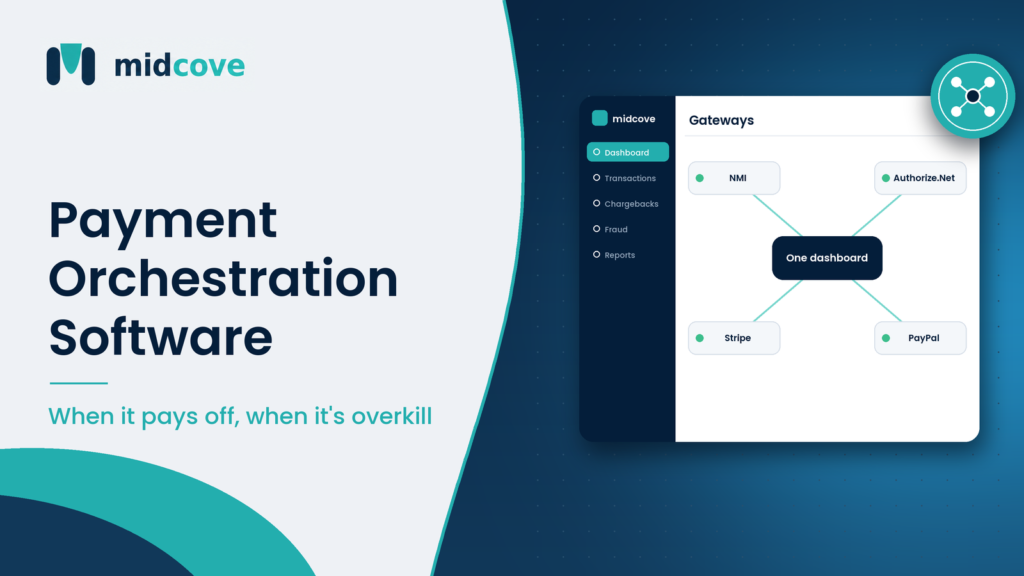
A payment gateway CRM is a management layer that sits on top of the merchant accounts you already have. It doesn’t decide where a transaction goes. You do, by assigning each store, product, or virtual terminal charge to a MID. What it does is everything after:
- One transaction dashboard across every gateway, with refunds and voids routed back to the original MID
- One chargeback queue with deadline tracking across all accounts
- Shared fraud block lists by IP, email, phone, and BIN with velocity lockouts
- Reporting on approval rates, refunds, and chargebacks per MID
- Role-based access so the right people touch the right accounts
- A single REST API across gateways for teams that want one integration
Midcove is this kind of tool, built for NMI, Authorize.Net, Stripe, and PayPal. To be specific about what it doesn’t do: no automatic routing, no least-cost routing, no load balancing, no smart retries, and no automatic failover. If your gateway goes down, you switch MIDs manually. For many merchants with a handful of accounts, that’s an acceptable trade for a much lower cost and same-day setup.
The two aren’t mutually exclusive either. A large merchant might orchestrate checkout traffic and still want a separate operations layer for disputes and fraud review. For a full map of who does what in the stack, see our sibling guide on payment orchestration vs payment gateway.
A Decision Guide
| Your situation | Likely best fit |
|---|---|
| One MID, one gateway, small team | Your gateway’s own dashboard |
| 2–5 MIDs split by brand, channel, or risk; pain is ops and visibility | Payment CRM / management layer |
| Multiple countries and currencies, local acquiring matters | Orchestration or a multi-acquirer PSP |
| High volume where a 1% approval lift is worth six figures | Orchestration, with a clear ROI case |
| Frequent provider outages costing real revenue | Orchestration with automatic failover |
| Need token portability across many providers | Orchestration with an independent vault |
Questions to ask any orchestration vendor
- Which of my current gateways and acquirers do you support today, in production?
- How do your retries respect card network reattempt rules and decline categories?
- Can I export my token vault if I leave, and in what format?
- What is your own PCI DSS level, and how does using you change my scope?
- What’s the full cost at my volume, including per-transaction fees and minimums?
- What happens to my checkout if your platform has an outage?
The last question matters. An orchestrator that removes single points of failure among gateways can become one itself.
Key Takeaways
- Payment orchestration software routes each transaction across multiple providers and adds retries, failover, a shared vault, and one API.
- Vendors range from independent platforms to PSP-led multi-acquirer setups to in-house builds.
- Costs include platform fees, per-transaction fees, implementation, and ongoing ops, on top of processing fees.
- Orchestration pays off at high volume, across many regions, or where outages are costly.
- It’s often overkill for merchants with a few MIDs split by brand or channel.
- A payment CRM handles visibility and operations across MIDs without automatic routing, at a lower cost and effort.
Frequently Asked Questions
What is the difference between a payment gateway and payment orchestration?
A payment gateway sends a transaction to one processor for authorization. Payment orchestration sits above several gateways or acquirers and decides which one handles each transaction, often adding retries, failover, and a shared token vault. You still need gateways or PSPs underneath an orchestration layer.
Who needs payment orchestration software?
Usually larger merchants processing in several countries or currencies, businesses with many payment providers, and companies where small approval-rate gains or outage protection are worth a lot of money. Smaller merchants with a few MIDs in one market often get more value from a simpler management layer.
How much does payment orchestration cost?
Pricing is mostly quote-based. Expect some mix of a platform subscription, a per-transaction fee, and implementation costs, on top of your normal processing fees. Ask for a total cost at your actual volume, including minimum commitments and renewal terms.
Does payment orchestration increase approval rates?
It can, by routing transactions to providers more likely to approve them and by retrying eligible soft declines. The lift varies widely by business, region, and card mix. Ask vendors for results from merchants similar to you, and measure your own baseline before you switch anything on.
Is payment orchestration PCI compliant?
Reputable orchestration vendors are PCI DSS compliant service providers, and their hosted fields or vaults can reduce how much card data touches your systems. Your own obligations don’t disappear. Check the vendor’s attestation and confirm which SAQ applies to your setup.
Can payment orchestration help with chargebacks?
Indirectly at best. Some platforms connect to fraud and dispute tools, but routing doesn’t reduce disputes on its own. Spreading volume across MIDs to keep ratios low breaks card network rules. Chargeback reduction comes from better fraud screening, clear descriptors, and good customer service.
What is a token vault in payment orchestration?
It’s secure storage for card data that the orchestrator controls rather than a single gateway. Because tokens aren’t tied to one processor, you can charge saved cards through any connected provider and switch providers without asking customers to re-enter cards.
What are alternatives to payment orchestration?
Alternatives include using one PSP with strong local acquiring, adding a manually managed backup MID, building simple routing rules in your own checkout, or using a payment CRM such as Midcove to manage several MIDs from one dashboard without automatic routing.
How long does it take to implement payment orchestration?
It depends on the number of providers, payment methods, and whether tokens need migrating. Simple setups can take a few weeks; complex multi-region projects can take several months of engineering and testing.
Buy for the Problem You Have
Payment orchestration software is a strong answer to a specific set of problems: many providers, many regions, real outage costs, and enough volume that a small approval lift is worth a lot. If that’s you, run the break-even test, press vendors on retries and vault portability, and go in with eyes open.
If your real headaches are three consoles, a dispute queue nobody owns, and fraud blocks that only exist on one account, you need control, not routing. That’s the gap Midcove fills: a management layer on top of the NMI, Authorize.Net, Stripe, or PayPal accounts you already have, with manual MID selection and no promises about routing it doesn’t do.
Need control more than routing?
Manage transactions, disputes, refunds, and fraud rules across your existing MIDs from one dashboard. Most merchants go live the same day.