Last updated: November 13, 2026
An online vape retailer doing $400,000 a month got a 30-day termination notice from its acquirer on a Tuesday. Nothing dramatic had happened. Disputes had crept up over two quarters, nobody was watching the ratio per MID, and there was no second account ready. The business spent the next month taking orders it couldn’t charge.
High-risk merchants don’t usually fail because of one bad day. They fail because the stack around the merchant account was thin. One MID, a default fraud setup, a vague descriptor, and a chargeback “process” that lived in somebody’s inbox.
This guide breaks down a practical high-risk merchant payment stack: the accounts, tools, and routines that keep you processing when your industry is under a microscope. We’ll cover each layer, what it protects against, and what it costs. We’ll also be blunt about compliance lines you shouldn’t cross, because several “tricks” sold to high-risk merchants will get you shut down faster. Where a payment CRM like Midcove fits, we’ll say so, and where it doesn’t, we’ll say that too.
A high-risk merchant payment stack is the set of merchant accounts, gateways, fraud controls, chargeback tools, and daily routines a high-risk business uses to accept cards reliably. It typically includes a high-risk MID, a properly underwritten backup MID, layered fraud filters, dispute alerts, clear descriptors, and per-MID ratio monitoring.
Table of Contents
Why High-Risk Processing Needs a Different Stack
Acquirers label a business high-risk when its category or history suggests more chargebacks, more fraud, or more regulatory exposure. Common examples include nutraceuticals, CBD, vape, online gaming, travel, adult content, tech support, and subscription-heavy models.
That label changes the rules you play by. You’ll usually see higher rates, a rolling reserve, tighter monitoring, and less patience when ratios slip. If you want the full breakdown, our guide to high-risk vs standard merchant accounts covers pricing and underwriting differences.
The practical result: a standard merchant can get away with a single account and basic tools. A high-risk merchant can’t. Every layer below exists because something specific goes wrong without it.
The 8 Layers of a High-Risk Merchant Payment Stack
Think of these as building blocks. Smaller businesses may start with five or six and add the rest as volume grows.
1. A primary high-risk MID with a specialist acquirer
Your merchant ID (MID) is the foundation. Work with an acquirer or ISO that actually underwrites your vertical, rather than squeezing onto an aggregator that may freeze funds once it notices your category.
Expect a rolling reserve. Many high-risk accounts hold back a percentage of each day’s sales, often in the 5% to 10% range, for around six months before releasing it. Build that into your cash flow model from day one.
2. A properly underwritten backup MID
A second merchant account, approved separately and in your real business name, is your insurance against a sudden freeze or termination. It also lets you split volume by brand or product line for legitimate reasons.
Our post on running a backup payment processor goes deeper. The key word is “properly.” Fully disclosed, separately underwritten, and used for real business reasons. More on that in the compliance section.
3. A gateway that fits high-risk
Many high-risk ISOs resell NMI, and Authorize.Net is common too. The gateway handles authorizations, stores tokens, and runs its own fraud tools. Choose one your acquirer supports and that gives you API access, a customer vault, and decent reporting.
4. Layered fraud filters
Card testing and stolen-card orders hit high-risk merchants hard because fraudsters know these businesses often accept more risk. A sensible baseline includes:
- AVS and CVV checks, with clear rules on which mismatches to decline
- Block lists for known bad IPs, emails, phone numbers, and card BIN ranges
- Velocity limits that lock out repeated failed attempts
- 3-D Secure on higher-value or higher-risk orders, where your gateway supports it
- Manual review for orders that trip several soft signals at once
Midcove’s fraud prevention tools add IP, email, phone, and BIN block lists plus an automatic 24-hour lockout after repeated failed attempts. They work alongside your gateway’s own filters, not instead of them.
5. Chargeback alerts
Alert networks such as Ethoca (owned by Mastercard) and Verifi (owned by Visa) can notify you when a cardholder starts a dispute, giving you a window to refund before it becomes a chargeback. Visa’s Rapid Dispute Resolution can even auto-resolve some cases under rules you set.
These services cost money per alert, so they suit merchants with enough dispute volume to justify the spend. Ask your processor or a chargeback vendor which ones fit your MIDs.
6. Clear, contactable descriptors
A huge share of “fraud” disputes in high-risk categories are really customers who don’t recognize the charge. Your statement descriptor should match the brand name the customer bought from, and include a phone number or website where your processor allows it.
If you sell several brands, each should show its own name. A single holding-company name on every statement invites confused calls to the bank.
7. Chargeback management and evidence workflow
When disputes do land, you need a queue, deadlines, and evidence templates for each reason code. Response windows are short, often one to three weeks, and a missed deadline is an automatic loss.
This is where multi-MID merchants struggle most. Disputes arrive in different gateway portals, and nobody sees the full picture. Midcove’s chargeback management software puts disputes from every connected MID into one queue with alerts, evidence upload, deadline tracking, and win-rate reporting.
8. Per-MID reporting and risk controls
The last layer ties everything together: reports that show approval rate, refund rate, and dispute ratio for each MID, every week. You can’t fix what you only see as a portfolio average.
Operational controls matter here too. Role-based access so only the right staff can refund or change settings. Clear limits on manual keyed transactions. And an audit trail when something goes wrong.
Stack summary table
| Layer | Protects against | Typical owner |
|---|---|---|
| Primary high-risk MID | Being shut out of card payments | Founder / finance |
| Backup MID | Freezes, terminations, single point of failure | Finance |
| Gateway | Integration gaps, weak reporting | Engineering |
| Fraud filters | Card testing, stolen cards, fraud reports | Risk / ops |
| Chargeback alerts | Disputes that could have been refunded | Support / risk |
| Descriptors | “I don’t recognize this charge” disputes | Ops / marketing |
| Chargeback workflow | Missed deadlines, lost winnable cases | Disputes team |
| Per-MID reporting | Problems hidden in averages | Finance / risk |
Ratio Thresholds You Must Watch
For high-risk merchants, card network monitoring programs are the line between “fine” and “account closed.” Thresholds change, so treat the numbers below as a starting point and confirm with your acquirer.
Visa VAMP
Visa now runs the Visa Acquirer Monitoring Program (VAMP), which combines reported fraud and disputes on card-not-present transactions into one ratio. According to Visa’s VAMP fact sheet, the program also has separate criteria for enumeration (card testing) attacks.
Visa has said it lowered the merchant “Excessive” threshold to 1.5% in the US, Canada, Europe, and Asia-Pacific from April 2026. Because fraud reports count alongside disputes, a card-testing attack can push your ratio up even if few of those cards ever file chargebacks. Our sibling post Visa VAMP explained walks through the formula.
Mastercard
Mastercard runs its own Excessive Chargeback and Excessive Fraud programs. The chargeback program has generally started at around 100 chargebacks and a 1.5% ratio in a single month, measured against the previous month’s transactions. Ask your acquirer for the current figures for your region.
Your acquirer’s own limits
Many high-risk acquirers set internal limits below the card brand thresholds. You might get a warning at 0.9% long before Visa or Mastercard notice. Read your merchant agreement for those numbers, then set your own alerts lower still.
Daily, Weekly and Monthly Ops Routine
Tools only work if someone uses them on a schedule. Here’s a routine we’ve seen work for teams running two to six high-risk MIDs.
- Daily: check overnight declines and fraud alerts. Look for spikes in declines from one BIN range or IP block, which often signal card testing.
- Daily: work the dispute queue. Respond to anything due within five days first. Refund alerts that are cheaper to refund than to fight.
- Daily: review refund requests. Fast refunds for genuine complaints keep disputes down.
- Weekly: pull ratios per MID. Dispute count, fraud report count, refund rate, and approval rate for each account.
- Weekly: update block lists. Add confirmed fraud signals; remove stale entries that block good customers.
- Monthly: reconcile reserves and settlements. Check that reserve releases match your agreement.
- Monthly: review descriptors and checkout disclosures. Make sure pricing, renewal terms, and contact details are still clear.
- Quarterly: test your backup MID. Run real, small transactions so you know it works before you need it.
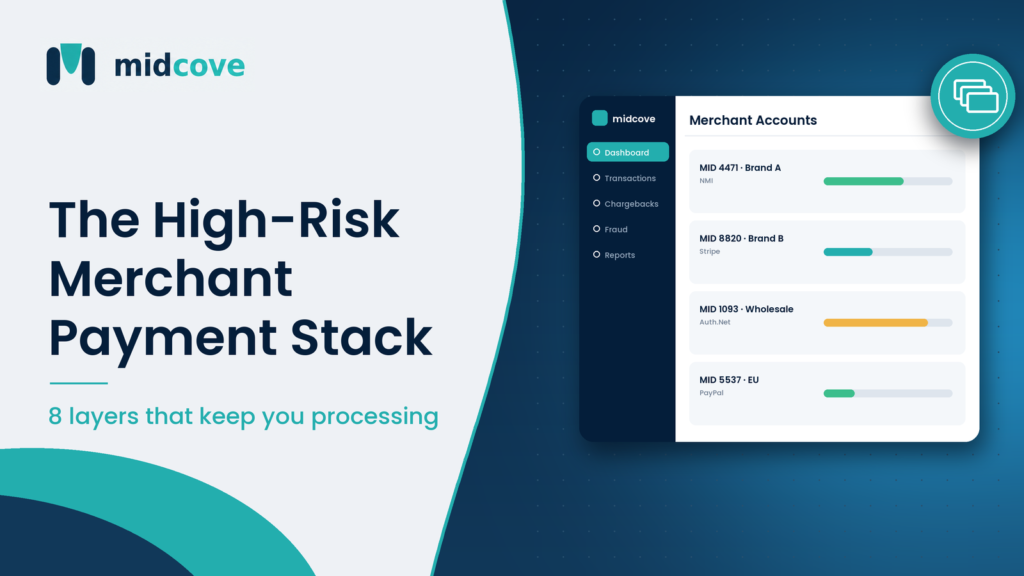
Running this across separate gateway logins is where time disappears. A multi-gateway processing view lets one person see every MID’s activity in one place. To be clear, Midcove doesn’t route transactions automatically or fail over between gateways. You choose which MID processes each payment, and the platform gives you the shared dashboard, reporting, and controls.
Compliance Cautions: What Not to Do
High-risk merchants get pitched a lot of shortcuts. Most of them break card network rules, and some break the law. Here’s what to avoid.
- MID stacking to hide chargebacks. Spreading volume across many accounts so no single MID crosses a threshold is a known red flag. Card networks and acquirers look for it, and getting caught can mean termination for every account involved.
- Transaction laundering. Processing sales for one business through another business’s merchant account is prohibited. It’s a fast route to fines and account closures.
- Miscoding your category. Using a lower-risk merchant category code (MCC) to get approved or get better rates misrepresents your business to the card networks. The public Visa Core Rules set out how merchants must be classified.
- Ignoring brand registration. Some high-risk categories must be registered with the card brands through your acquirer. Ask whether yours is one of them.
- Hiding subscription terms. If you bill on a recurring basis, US law under the Restore Online Shoppers’ Confidence Act requires clear disclosure, express consent, and a simple way to stop charges.
Termination for these reasons can also land your business on Mastercard’s MATCH list, a shared database acquirers check before approving new accounts. Being listed makes it very hard to get a new merchant account for years.
Legitimate reasons for multiple MIDs do exist: separate brands, separate legal entities, different regions, or a disclosed backup. Our guide to multiple MIDs for multiple brands explains where the line sits.
Key Takeaways
- A high-risk merchant payment stack needs more than one merchant account and default gateway settings.
- Plan for a rolling reserve and a separately underwritten backup MID before you need either.
- Layer fraud controls: AVS/CVV, block lists, velocity lockouts, 3-D Secure, and manual review.
- Clear descriptors and fast refunds prevent many disputes that look like fraud.
- Track dispute and fraud ratios per MID weekly; Visa’s VAMP counts fraud reports alongside disputes.
- Never use MID stacking, transaction laundering, or miscoded MCCs; they can lead to MATCH listing.
- A payment CRM gives you one view across MIDs, but MID selection and compliance decisions stay with you.
Frequently Asked Questions
What makes a merchant high-risk?
Acquirers look at your industry, chargeback history, refund rate, average ticket, billing model, and where you sell. Categories like nutraceuticals, CBD, vape, travel, gaming, and subscription services are often classed as high-risk. A poor processing history or a new business with large expected volume can also push you into that category, even in a normal vertical.
Do high-risk merchants need a backup merchant account?
It’s strongly recommended. High-risk accounts are more likely to face reserves, holds, or termination at short notice. A second, separately underwritten MID gives you somewhere to process if that happens. It must be approved in your real business name and used for legitimate reasons, never to hide chargebacks.
What is a rolling reserve?
A rolling reserve is a percentage of your daily card sales that the acquirer holds back for a set period, then releases. High-risk accounts often see reserves in the 5% to 10% range held for around six months. It protects the acquirer against future chargebacks and refunds, so plan your working capital around it.
What chargeback ratio is too high for a high-risk merchant?
Card brand thresholds sit around 1.5% for Visa’s VAMP merchant level in many regions and for Mastercard’s excessive chargeback program, but your acquirer may act much earlier. Many high-risk merchants aim to stay well under 1%. Check your merchant agreement for internal limits and set alerts below them.
Is MID stacking illegal?
Using several MIDs isn’t wrong in itself. Spreading volume across accounts specifically to keep each one under monitoring thresholds is what card networks treat as abuse, and acquirers actively look for it. Getting caught can lead to termination, fines, and a MATCH listing. Keep every MID disclosed and tied to a real business purpose.
What is the MATCH list?
MATCH (Member Alert to Control High-risk Merchants) is a Mastercard database of businesses whose merchant accounts were terminated for specific reasons, such as excessive chargebacks or fraud. Acquirers check it before approving new applicants. A listing typically stays for years and makes getting a new merchant account very difficult.
How do chargeback alerts work?
Alert services like Ethoca and Verifi pass you early notice when a cardholder contacts their bank about a charge. You then have a short window to refund before the dispute becomes a formal chargeback. Some, like Visa’s Rapid Dispute Resolution, can resolve cases automatically using rules you set in advance. Fees are charged per alert.
Can a payment CRM route transactions between high-risk MIDs automatically?
Some orchestration platforms do automated routing. Midcove doesn’t. It lets you run multiple MIDs side by side under one login and choose which MID processes each payment, with shared reporting, fraud filters, and a single chargeback queue. That keeps routing decisions in your hands, which also helps you stay inside card network rules.
Building a High-Risk Stack That Lasts
A durable high-risk merchant payment stack isn’t about one clever tool. It’s a specialist MID, a real backup, layered fraud controls, clear descriptors, fast refunds, and a disciplined routine that tracks every ratio per account. Get those right and you’ll ride out the bad months instead of losing your ability to take cards.
Stay on the right side of the rules, too. Disclosed MIDs, honest category codes, and transparent billing protect you far better than any workaround.
Midcove helps by giving high-risk teams one place to manage the merchant accounts they already have with NMI, Authorize.Net, Stripe, or PayPal: fraud filters, chargeback cases, and reporting across every MID. For a closer look at the controls, see our merchant risk management tools.
Run every high-risk MID from one dashboard
Connect your existing merchant accounts, add fraud filters and a unified chargeback queue, and track ratios per MID without juggling portals.