Last updated: October 29, 2026
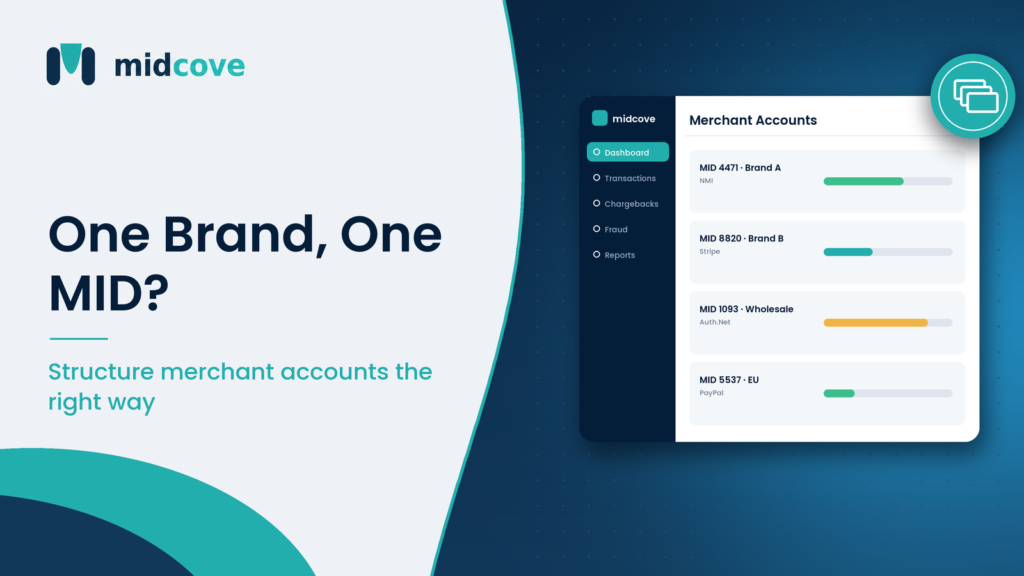
A holding company launches its third brand. The founder asks a fair question: can we just run it through the existing merchant account? It’s the same team, the same warehouse, and the same bank. Setting up another account feels like paperwork. Do you really need multiple MIDs for multiple brands?
Sometimes it is. More often, putting a new brand on an old MID creates confused customers, the wrong merchant category, and a risk profile your acquirer never approved. And on the other side, some businesses split brands across accounts for the wrong reason: to keep each account’s chargeback ratio under the limit. That one can end with every account closed.
This guide covers how to set up multiple MIDs for multiple brands the right way. We’ll look at structuring by brand, legal entity, and region; how descriptors and merchant category codes fit in; the card network rules on transaction laundering and MID stacking; and how to disclose your structure so underwriters say yes. Midcove works with businesses that run several brands on separate MIDs, so we’ll close with the operational side too.
Should each brand have its own MID? Usually yes, when brands have different names on the statement, different legal entities, different products or risk levels, or sell in different regions. Separate MIDs are legitimate when they reflect real business lines and are disclosed to the acquirer. Splitting volume to hide chargebacks is not.
Table of Contents
- Legitimate reasons to give each brand a MID
- Structuring MIDs by brand, entity, or region
- Descriptors and MCCs for each brand
- The rules: transaction laundering and MID stacking
- How to disclose a multi-brand structure to your acquirer
- Running multiple MIDs for multiple brands day to day
- Key Takeaways
- Frequently Asked Questions
- One brand, one honest account
Legitimate reasons to give each brand a MID
A merchant ID isn’t just an account number. It carries a business name, a category code, a descriptor, an underwriting file, and a risk profile. When a second brand differs on any of those, it usually deserves its own account.
The customer sees a different name
Say a company sells a home fragrance line called “Ember & Oak” and a kids’ coding app called “ByteSprout.” If both charge under the parent’s name, parents see “HARBORLINE HOLDINGS” and have no idea what it is. That’s a fast route to “unrecognized transaction” disputes.
The products carry different risk
Physical goods shipped once look nothing like a monthly app subscription. Refund patterns, dispute reasons, and fraud exposure differ. Underwriters price and set reserves on the profile they approved. Adding a subscription to a one-time-sale account changes that profile without telling them.
The brands sit in different legal entities
If each brand is its own company, each needs its own merchant agreement. The entity that signs is the one liable for chargebacks, and the one whose taxpayer ID goes on tax reporting.
The brands sell in different regions
A Dubai-based food group running a delivery brand in the UAE and a separate catering brand in Saudi Arabia will often need local acquiring in each market, with different settlement currencies. Separate MIDs follow naturally.
You want clean reporting and control
Separate MIDs give each brand its own P&L view, its own approval rate, and its own dispute history. If one brand hits trouble, it’s visible and contained, not mixed into another brand’s numbers.
Structuring MIDs by brand, entity, or region
There’s no single correct way to lay out multiple MIDs for multiple brands. Most setups combine three dimensions: brand, legal entity, and region. Pick the main split based on what changes the most between your businesses.
| Structure | Best for | Trade-offs |
|---|---|---|
| One MID per brand, one entity | Several consumer brands owned by one company | Simple contracts; acquirer still sees combined exposure across MIDs |
| One MID per legal entity | Brands held in separate companies | Clean liability lines; more applications and bank accounts |
| One MID per brand per region | Brands selling in several countries or currencies | Local acquiring and better approvals; more accounts to reconcile |
| Shared MID with dynamic descriptors | Closely related product lines under one brand | Fewer accounts; only works if products share a category and risk profile |
When one MID is still fine
Not every product line needs its own account. A coffee roaster selling beans, grinders, and gift cards under one brand name can stay on one MID. Same customers, same category, same statement name. Splitting there just adds reconciliation work.
A simple test: if a customer would recognize the descriptor, the category code is accurate, and your underwriter would describe both products the same way, one MID is probably fine.
Descriptors and MCCs for each brand
Two fields do most of the work in a multi-brand setup: the descriptor and the merchant category code (MCC).
Descriptors
The descriptor should match the brand name the customer saw at checkout. Where your processor supports it, add a URL or phone number. Some gateways allow dynamic or soft descriptors that change per transaction within limits, but these work best for variations of one brand, not for running an unrelated brand through someone else’s account.
Descriptors also affect how networks see you. Stripe’s guide to card network monitoring programs notes that Visa identifies a monitored account by its statement descriptor and acquiring bank. So a new descriptor can mean a new monitored identity, and descriptor changes should be coordinated with your processor.
Merchant category codes
The MCC tells issuers what kind of business you are. It affects interchange, fraud models, and whether some issuers approve at all. Each MID’s MCC must match what’s actually sold on it. Selling an app subscription on a MID coded for home furnishings is a misrepresentation, even if nobody intended it.
The rules: transaction laundering and MID stacking
This is the part most “multiple MIDs” articles skip. Card networks allow businesses to hold several merchant accounts. They don’t allow those accounts to disguise who is selling what, or how risky it is.
Transaction laundering
Transaction laundering happens when one merchant processes payments for another business through its own account. The cardholder thinks they bought from Store A; the money actually paid for Business B, which never got approved. Networks treat this seriously because it can hide prohibited or high-risk sales. Visa’s public Core Rules require merchants to be accurately identified, and Mastercard runs a dedicated program, known as BRAM, aimed at illegal or brand-damaging transactions.
For a multi-brand company, the practical risk is accidental. A new brand launches before its MID is approved, so “just for a few weeks” its sales go through the sister brand’s account. That’s the textbook pattern, even if the products are legal. Wait for the approval.
MID stacking and load balancing
MID stacking, also called load balancing, means opening several accounts and spreading sales across them so each stays below a chargeback or fraud threshold. It doesn’t change your real dispute rate. It just hides it.
Networks and acquirers look for it. So do regulators. In its case against Apex Capital Group, the FTC described load balancing as “opening numerous merchant accounts for the purpose of spreading sales volume,” and alleged the defendants used shell companies with straw owners to get those accounts. The FTC later added the processor and its CEO to the case, which shows acquiring partners face consequences too.
Signs that look like stacking, even when you’re honest
Underwriters can’t read your intent. They read patterns. These raise flags:
- Several MIDs selling the same product under different names.
- Volume that shifts from one MID to another right after a ratio warning.
- Websites with near-identical layouts but different brand names.
- Accounts opened under new entities with the same owners but no disclosed link.
- Descriptors that don’t match the website taking the order.
If any of these describe your setup for a legitimate reason, explain it before the acquirer asks.
How to disclose a multi-brand structure to your acquirer
The fix for almost every risk above is disclosure. Acquirers approve multi-brand merchants all the time. They decline the ones that surprise them.
- Map your brands. List each brand, its legal entity, website, products, MCC, and expected monthly volume and average ticket.
- Show ownership. Name the beneficial owners across all entities. Don’t let the acquirer discover common ownership on its own.
- Explain the split. State why each brand needs its own MID: different names, products, entities, or regions.
- Provide history. Share processing statements and chargeback ratios for existing MIDs, including any that ran high and what you changed.
- Match the details. Make sure website, descriptor, MCC, refund policy, and contact details agree for each brand.
- Launch after approval. Don’t process a new brand’s sales anywhere until its own MID is live.
If one brand is higher risk, it may need a different acquirer or a high-risk merchant account with its own reserve. That’s fine. Keeping it separate protects your lower-risk brands’ accounts.
Running multiple MIDs for multiple brands day to day
Once the structure is approved, the job becomes operational. Each brand needs the right sale on the right account, clean reporting, and its own dispute tracking.
Keep each sale on its brand’s MID
For online checkout, each brand’s site should be wired to its own gateway account. For phone and email orders, staff need to pick the right MID every time. A rep who runs an Ember & Oak order on ByteSprout’s account creates a descriptor mismatch and, if it’s disputed, a hard case to win.
Report by brand, then roll up
Look at volume, approval rates, refunds, and chargebacks per MID first, then combine. That keeps one brand’s problems from being diluted in a group total. For the routine side of this, see our guide on how to manage multiple merchant accounts.
Where a payment CRM helps
Midcove connects to the merchant accounts you already hold on NMI, Authorize.Net, Stripe, and PayPal, so each brand keeps its own MID and processing history. Your team sees every brand in one place with multi-gateway processing. In the virtual terminal, staff choose the MID for each phone order, and permissions can limit who can charge on which brand’s account.
What it deliberately doesn’t do: Midcove doesn’t route or split transactions across MIDs automatically, and it’s not a tool for spreading volume. Each sale goes to the account you choose. For a multi-brand business trying to stay clean with its acquirers, that’s a feature.
Key Takeaways
- Separate MIDs make sense when brands differ in name, entity, product risk, or region.
- Each MID’s descriptor must match the brand at checkout, and its MCC must match what’s sold.
- Never run a new brand’s sales through a sister brand’s MID while waiting for approval.
- MID stacking (load balancing) to hide chargebacks breaks card network rules and has drawn FTC action.
- Disclose common ownership and the reason for each split to every acquirer.
- Report per brand first, then roll up, so one brand’s problems stay visible.
Frequently Asked Questions
Can I use one merchant account for multiple businesses?
Only if the businesses are really one business: same legal entity, same brand name on the statement, same category, and products your acquirer approved. Running a separate business through your account without approval can count as transaction laundering. If the brands differ, ask your acquirer about separate MIDs.
Is having multiple merchant accounts legal?
Yes. Many businesses hold several merchant accounts for different brands, entities, channels, or regions. It becomes a problem when accounts hide who is selling, misstate what’s sold, or split volume to keep chargeback ratios under network thresholds. Disclose your structure and keep each MID tied to a real business line.
What is MID stacking?
MID stacking, or load balancing, is spreading sales across several merchant accounts so each one stays below chargeback or fraud limits. The real dispute rate doesn’t change; it’s just hidden. Card networks prohibit it, acquirers screen for it, and the FTC has described it in enforcement cases.
What is transaction laundering?
Transaction laundering is when one merchant processes payments for a different business through its own account. The cardholder sees one merchant, but the sale belongs to another that was never approved. It can hide illegal or high-risk sales, so networks and acquirers monitor for it closely.
Do I need a separate MID for each website?
Not always. If several sites sell the same brand and products under the same descriptor, one MID may be fine. If sites carry different brand names, different products, or different risk levels, separate MIDs are usually cleaner. Check with your acquirer, since each MID is approved for specific websites.
Can different brands share one billing descriptor?
They can, but it often backfires. Customers who bought from one brand won’t recognize the other brand’s name on their statement, which leads to unrecognized-charge disputes. Dynamic descriptors can vary text within one MID, but they work best for variations of a single brand.
How do acquirers view several MIDs under the same owner?
Acquirers generally look at combined exposure across related accounts. Common ownership isn’t a problem when it’s disclosed with a clear reason for each account. It becomes a red flag when they discover it on their own, especially if volume moves between accounts after a ratio warning.
Does a new brand need new underwriting?
Usually, yes. A new MID is approved for a specific business, website, and category, so the acquirer reviews it. If you already have a strong history on other accounts, share it. Strong processing history and clean dispute ratios can make approval faster.
One brand, one honest account
Running multiple MIDs for multiple brands is normal and often smart. It keeps descriptors clear, matches each account to its real risk, and gives every brand its own reporting. The line you can’t cross is using accounts to hide: hiding which business made the sale, or hiding a dispute rate by spreading it thin.
Structure by brand, entity, or region based on what actually differs. Disclose ownership and the reason for each split. Launch a brand only after its own MID is approved. Then keep each sale on the right account, every time. Midcove helps with that last step by putting every brand’s MID behind one login while leaving routing decisions with you.
Running several brands on separate MIDs?
See how Midcove keeps each brand’s merchant account, transactions, and chargebacks organized in one place.